How Confluent's Shift to Kafka Headers for Schema IDs Enhances Governance
In a move to streamline schema management, Confluent has introduced a new approach in Apache Kafka that relocates schema IDs from message payloads to record headers. This update integrates tightly with Confluent Schema Registry and aims to simplify schema governance, improve compatibility across serialization formats, and reduce the coupling between data and metadata in event-driven architectures. Below, we answer key questions about this change and its implications.
Why did Confluent move schema IDs to Kafka headers?
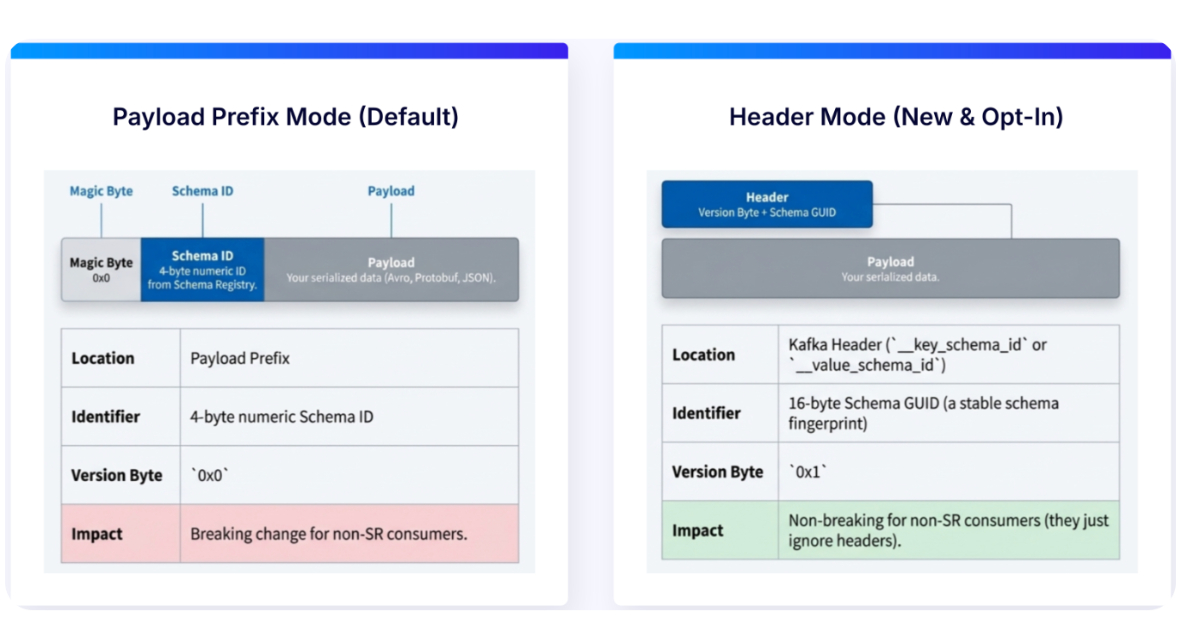
Historically, schema IDs were embedded inside the message payload, which tightly coupled the data with its metadata. This made schema evolution harder because consumers had to parse the payload to extract the ID before looking up the schema. By moving the ID to Kafka record headers, Confluent decouples the schema reference from the actual data. This structural separation allows producers and consumers to handle metadata independently, reducing complexity when evolving schemas. Additionally, headers are processed more efficiently by Kafka’s internal routing, and they don’t interfere with the payload’s serialization format. The change is especially beneficial in multi-format environments where different parts of the system may use Avro, Protobuf, or JSON Schema.
How does this update simplify schema governance?
Schema governance involves managing versions, ensuring compatibility, and enforcing rules across a distributed system. With schema IDs in headers, governance becomes more transparent because metadata is separate from business data. Administrators can apply policies on header-based routing, monitor schema usage without peeking inside payloads, and enforce schema evolution rules more cleanly. For example, a schema registry can now expose a dedicated endpoint to validate header IDs, and consumers can reject messages with incompatible schemas before even deserializing the payload. This reduces runtime errors and makes governance tools easier to build and maintain. The move also aligns with the industry trend of separating concerns in event-driven systems.
What are the benefits for serialization formats like Avro, Protobuf, and JSON Schema?
Different serialization formats have different ways of handling schemas. Previously, each format had to embed the schema ID within its own binary or textual envelope, leading to format-specific quirks. By placing the ID in headers, Confluent removes this format dependency. Avro, Protobuf, and JSON Schema messages all leverage the same header-based ID reference, which simplifies consumers that must support multiple formats. A single deserialization logic can read the header, look up the schema, and then apply the appropriate format-specific parsing. This reduces code duplication and improves interoperability. Moreover, header-based IDs enable lightweight schema validation at the transport layer before any format-specific processing, enhancing overall system performance and reliability.
How does this affect event-driven architectures?
Event-driven architectures rely on loose coupling and independent evolution of services. Moving schema IDs to headers reduces the coupling between event producers and consumers because the schema metadata is no longer buried in the payload. Consumers can decide which schema version to use based on the header without needing to parse the entire event body. This separation also simplifies event sourcing and CQRS patterns, where events may need to be replayed or transformed. Additionally, header-based IDs enable better compatibility checks during schema registration. Services can now validate that an event’s schema ID is compatible with the expected version without loading the actual payload, making schema evolution safer and more scalable in large microservice ecosystems.
/presentations/game-vr-flat-screens/en/smallimage/thumbnail-1775637585504.jpg)
Will existing Kafka clients or serializers need to be updated?
Yes, to take advantage of header-based schema IDs, both producers and consumers need to update their serializers and deserializers. Confluent has updated its own client libraries (like the Java KafkaAvroSerializer) to support this mode. The change is backward compatible: clients can still read messages with schema IDs in the payload, but new messages can optionally use headers. Administrators can gradually migrate by enabling the header feature on producers and updating consumers to read from both locations. Confluent recommends a phased rollout to avoid breaking existing pipelines. The Schema Registry itself has been enhanced to handle both payload-based and header-based IDs, ensuring a smooth transition.
What is the role of the Schema Registry in this change?
Confluent Schema Registry remains the central hub for schema storage and versioning. With the new approach, the registry’s API is extended to support retrieval of schemas based on header IDs. The registry can also validate that the schema ID in the header matches a registered version, and it provides endpoints for managing compatibility policies that now apply to header-based references. Importantly, the registry does not store the ID in the payload; it only associates the ID with a schema. This separation allows the registry to serve as a pure metadata store, improving its scalability. The registry’s compatibility checks now operate on the schema itself and the header ID, making them more robust.
How does this change reduce coupling between data and metadata?
In a traditional setup, the message payload contains both the business data and the schema ID, meaning anyone who processes the record must first parse the payload to access the metadata. This creates a tight coupling: the payload format dictates how metadata is extracted. By moving the schema ID to Kafka record headers, metadata is lifted to the transport layer, separate from the data. Now, Kafka brokers, consumers, and monitoring tools can inspect the schema ID without deserializing the payload. This separation is a key principle of event-driven design because it allows the data and its description to evolve independently. For example, you can change the schema version without altering the payload structure, and vice versa, leading to cleaner system architecture and easier troubleshooting.