Navigating Defense Startup Funding: The Destinus €200M Pre-IPO Round Case Study
Overview
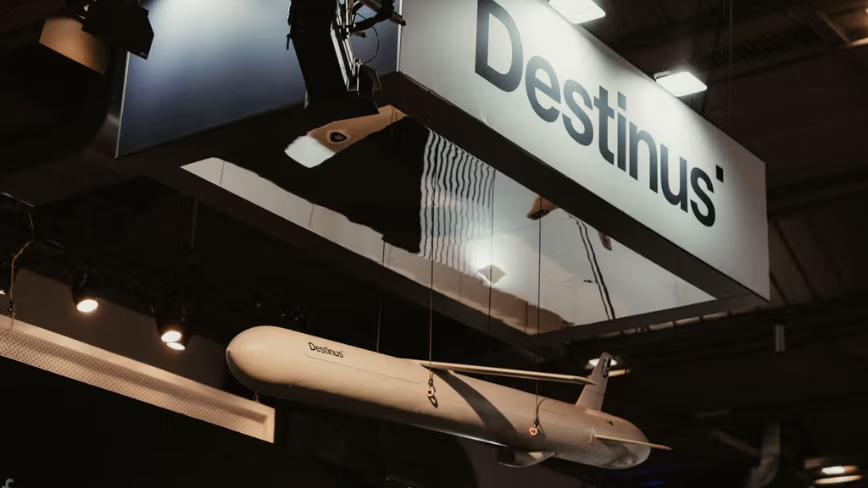
Defense technology is a capital-intensive sector with unique regulatory and market dynamics. In early 2025, Destinus—a Netherlands-based manufacturer of cruise missiles and autonomous drones—made headlines as it prepared to raise approximately €200 million in a pre-IPO round, targeting a valuation of €5 billion based on forecast annual revenues of roughly €500 million. This case study walks through the strategic rationale, valuation mechanics, and execution steps behind such a funding event, providing a practical guide for entrepreneurs and investors navigating similar high-stakes capital raises in defense or other regulated industries.
Prerequisites
Before diving into the step-by-step, ensure you understand these core concepts:
- Funding rounds: Series A, B, C, and pre-IPO or mezzanine rounds.
- Valuation methods: Revenue multiples, discounted cash flow (DCF), and market comps.
- IPO mechanics: Underwriting, prospectus, roadshow, and listing.
- Regulatory environment: Export controls (ITAR, EAR), foreign ownership restrictions, and government contracting.
Step-by-Step Instructions
1. Understanding the Pre-IPO Round
Destinus is raising a pre-IPO round—a bridge between late-stage venture financing and public listing. This round typically serves to:
- Inject growth capital for scaling production or R&D.
- Improve balance sheet metrics (e.g., reduce debt) before going public.
- Bring in institutional investors who can anchor the IPO.
Destinus targets €200 million. At an estimated €500 million revenue, this is a 0.4× pre-money revenue multiple on the new cash alone—but the valuation story depends on the company's enterprise value.
2. Setting the Valuation: The Revenue Multiple Approach
Valuing a defense startup requires adjusting for government contract risk, growth rates, and exit potential. Destinus is seeking a €5 billion valuation on €500 million forecast revenue—a 10× revenue multiple. For comparison:
- Mature defense primes (Lockheed Martin, RTX) trade at 2-3× revenue.
- High-growth defense tech startups (e.g., Anduril) have reached 10-15× revenue.
To model this, use the following Python snippet (or Excel equivalent):
forecast_revenue = 500_000_000  # in EUR
valuation_multiple = 10
target_valuation = forecast_revenue * valuation_multiple
print(f"Target valuation: €{target_valuation:,.0f}")  # Output: €5,000,000,000
This simple multiple ignores dilution, debt, or cash. A more precise calculation would subtract net debt and add cash to get enterprise value, then divide by revenue. For Destinus, the €5B likely represents post-money equity value including the new €200M.
3. Preparing for IPO: Financials, Compliance, and Story
Before the IPO, Destinus must:
- Audit financial statements to IFRS or GAAP standards.
- Establish compliance with exchange listing rules (e.g., Euronext or NYSE).
- Craft the equity story: Emphasize proprietary technology, government contracts, and geopolitical tailwinds.
- Secure underwriters (e.g., Goldman Sachs, Morgan Stanley) to price and distribute shares.
The pre-IPO round often includes convertible notes or SAFEs that convert at a discount to the IPO price. Destinus may use this structure to attract strategic investors.

4. Executing the Raise and IPO Timeline
A typical timeline:
- Months 1-3: Due diligence by pre-IPO investors. Focus on revenue visibility, IP protection, and export licenses.
- Months 3-5: Finalize valuation negotiations. Destinus’s €5B target implies investors accept ~10× revenue—a bold bet on growth.
- Months 5-8: Close pre-IPO round, then launch IPO roadshow.
- Month 9: IPO pricing and listing.
Realistically, the defense sector’s longer sales cycles may push timing. Destinus must also navigate national security reviews if listing abroad.
Common Mistakes to Avoid
Overestimating Valuation Without Comparable Track Record
A 10× revenue multiple on €500M forecast is aggressive. Many defense startups fail to hit revenue projections due to contract delays. Mitigation: Ensure firm orders or signed contracts back at least 60% of forecast.
Neglecting Regulatory Hurdles
Defense startups face strict export controls. If Destinus has international investors (e.g., non-NATO), import/export licenses may delay IPO or require a trust structure.
Ignoring Dilution Impact
Issuing €200M at a €5B pre-money valuation means new investors own about 4% of the post-money company. But if previous rounds had convertible instruments, effective dilution could be higher. Always model fully diluted shares.
Weak IPO Preparation
Rushing to IPO without robust internal controls can lead to public market failure. Destinus should invest in CFO expertise and compliance systems months in advance.
Summary
The Destinus €200M pre-IPO round illustrates how defense startups leverage strategic fundraises to bridge to public markets. By understanding valuation mechanics (e.g., revenue multiples), regulatory nuances, and execution steps, entrepreneurs can replicate this playbook—but only with rigorous financial modeling and a clear equity story. The €5B valuation remains aspirational until revenue materializes, but if executed well, this case study offers a roadmap for high-growth defense tech financing.