10 Key Insights into Reinforcement Learning Without Temporal Difference Learning
Reinforcement learning (RL) has long relied on temporal difference (TD) methods like Q-learning to train agents. However, TD learning struggles with long-horizon tasks due to bootstrapping error accumulation. A new paradigm—divide and conquer—offers an alternative that sidesteps these issues entirely. In this article, we explore ten essential facts about RL without TD learning, from its motivation to its practical implications. Whether you're a researcher or practitioner, understanding this shift can reshape how you approach complex decision-making problems.
1. The Core Problem with Temporal Difference Learning
TD learning updates value estimates using the Bellman equation: Q(s,a) = r + γ max Q(s',a'). While elegant, this bootstrapping step propagates errors from future states back to current states. Over long horizons, these errors compound, leading to inaccurate value functions and unstable training. For instance, in a 1000-step task, even small per-step errors can grow exponentially, making TD impractical for many real-world applications. This fundamental scaling challenge is why researchers seek alternatives that avoid recursive bootstrapping.
2. Monte Carlo Returns: A Purely Offline Alternative
Monte Carlo (MC) methods use complete returns from entire episodes—summing all rewards without bootstrapping. This eliminates error propagation entirely, as no future-state estimates are needed. However, naive MC requires full episode completions, which can be inefficient and high-variance. In off-policy settings, MC can leverage old data from diverse sources (e.g., human demos or past policies), making it more flexible than on-policy approaches. The trade-off? Higher variance in return estimates, especially for long episodes with sparse rewards.
3. Divide and Conquer: A New Paradigm for Off-Policy RL
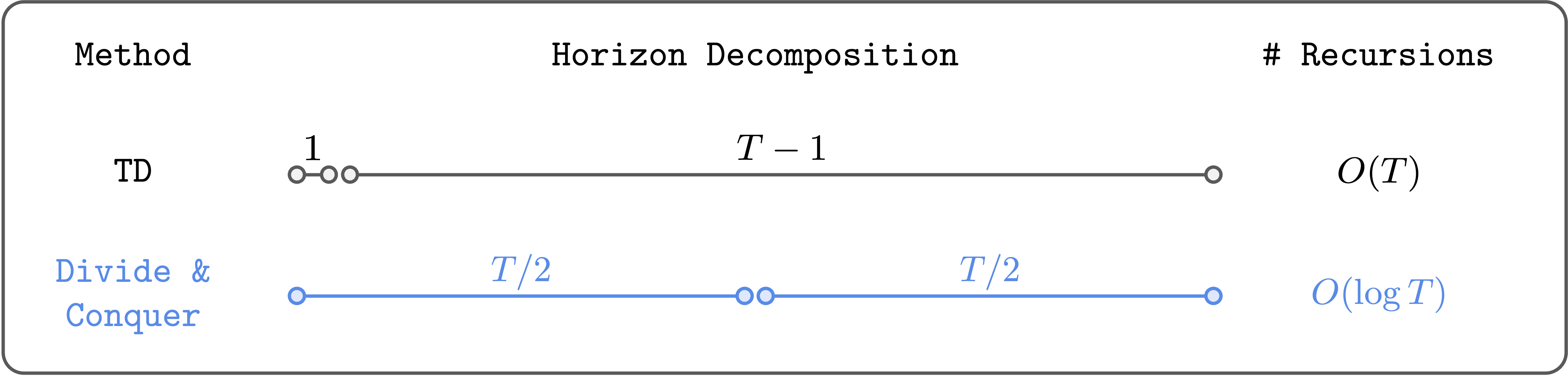
The divide-and-conquer approach breaks a long-horizon decision-making problem into smaller subproblems, each solved independently using Monte Carlo returns. Instead of learning a single value function via TD, an agent learns to decompose tasks into subtasks (e.g., reaching intermediate milestones). The value for each subtask is estimated purely from data—no bootstrapping across subtask boundaries. This isolates error accumulation to within each subproblem, drastically reducing overall propagation. The algorithm can be seen as a form of hierarchical RL without temporal difference updates.
4. How It Avoids Error Propagation
By avoiding TD bootstrapping, divide-and-conquer prevents errors from traveling through time. Each subtask's value estimate is computed directly from empirical returns (e.g., average discounted reward for that subtask segment). Because these estimates are independent, a mistake in one subtask's value does not corrupt others. This is analogous to how Monte Carlo methods avoid propagation, but here, the decomposition enables efficient reuse of data across subtasks. For example, a robot learning to assemble a product might first learn subtasks like 'pick part' and 'fasten screw' separately, each from offline demos.
5. Comparison with n-Step TD and TD(λ)
Traditional remedies like n-step TD or TD(λ) blend MC and TD to reduce bootstrapping steps. In n-step TD, the first n steps use real returns, and only then does bootstrapping begin. This reduces error accumulation by a factor of n, but does not eliminate it entirely. TD(λ) applies an exponential weighting of returns at different horizons. While these methods improve stability, they still rely on some bootstrapping, making them less robust than a fully MC-based divide-and-conquer approach. For very long horizons (n large), TD(n) becomes similar to MC, but still requires careful tuning of n or λ.
6. Off-Policy Capabilities: Why This Matters
Off-policy RL allows learning from any data, not just current policy rollouts. This is crucial in domains like robotics or healthcare, where data collection is costly or dangerous. TD-based off-policy methods (like Q-learning) often suffer from deadly triads (off-policy, function approximation, bootstrapping) that cause divergence. Divide-and-conquer, being bootstrapping-free, is more stable off-policy. It can leverage large offline datasets, including suboptimal demonstrations, to learn subtask-level policies without requiring online interaction. This makes it a promising candidate for sample-efficient, real-world RL.

7. Scalability to Long-Horizon Tasks
Long-horizon tasks (e.g., 1000+ steps) are where TD methods typically fail. Error accumulation makes Q-values unreliable beyond a few hundred steps. Divide-and-conquer scales naturally: the horizon of each subtask can be limited (e.g., 50 steps), so MC returns have manageable variance. The overall task horizon is the sum of subtask horizons, but errors do not compound across subtasks. Empirical results (as of 2025) show that divide-and-conquer can solve tasks with thousands of steps that are intractable for standard Q-learning or even actor-critic methods.
8. Integration with Human Demonstrations and Prior Knowledge
Because divide-and-conquer relies on offline data, it easily incorporates human demonstrations or expert trajectories. Users can provide examples of subtask completion, which the algorithm uses to estimate subtask returns. This is particularly useful in robotics, where humans can teleoperate robot arms for short segments. The algorithm does not require full task demonstrations—just examples of each subtask under any policy. This flexibility reduces the burden on data collection and accelerates learning of complex behaviors.
9. Challenges and Open Questions
Despite its advantages, divide-and-conquer RL is not a panacea. Subtask decomposition itself is a hard problem—how to automatically segment a task into meaningful subtasks without supervision? Current approaches often assume known subtask boundaries or use heuristics (e.g., time-based splitting). Additionally, MC returns within subtasks can still have high variance if subtask lengths are variable or rewards are sparse. Combining divide-and-conquer with function approximation (neural networks) also introduces approximation errors, though less severe than bootstrapping. Research is ongoing to automate decomposition and stabilize learning.
10. Future Directions Beyond TD Learning
The divide-and-conquer paradigm opens the door to other non-TD methods. For example, using Monte Carlo tree search (MCTS) for subtask planning, or leveraging successor representations without bootstrapping. Another direction is hybrid approaches that use TD within subtasks (where horizons are short) and MC across subtasks. As of 2025, the field is moving toward scalable off-policy algorithms that break free from bootstrapping chains. Understanding these principles is essential for anyone building RL systems for complex, real-world tasks where TD learning currently falls short.
In conclusion, reinforcement learning without TD learning is not only possible but offers distinct advantages for long-horizon, off-policy settings. The divide-and-conquer approach mitigates error propagation, scales well with task length, and integrates easily with offline data. While challenges remain—especially around automatic subtask decomposition—the paradigm represents a significant step forward. By moving beyond bootstrapping, we unlock new ways to apply RL to problems that were previously out of reach. Whether you are developing for robotics, healthcare, or dialogue systems, consider how non-TD methods could improve your outcomes.